¶ Zones
In Armounaut, characters will face conflicts across distances that are much greater than in most other RPG systems.
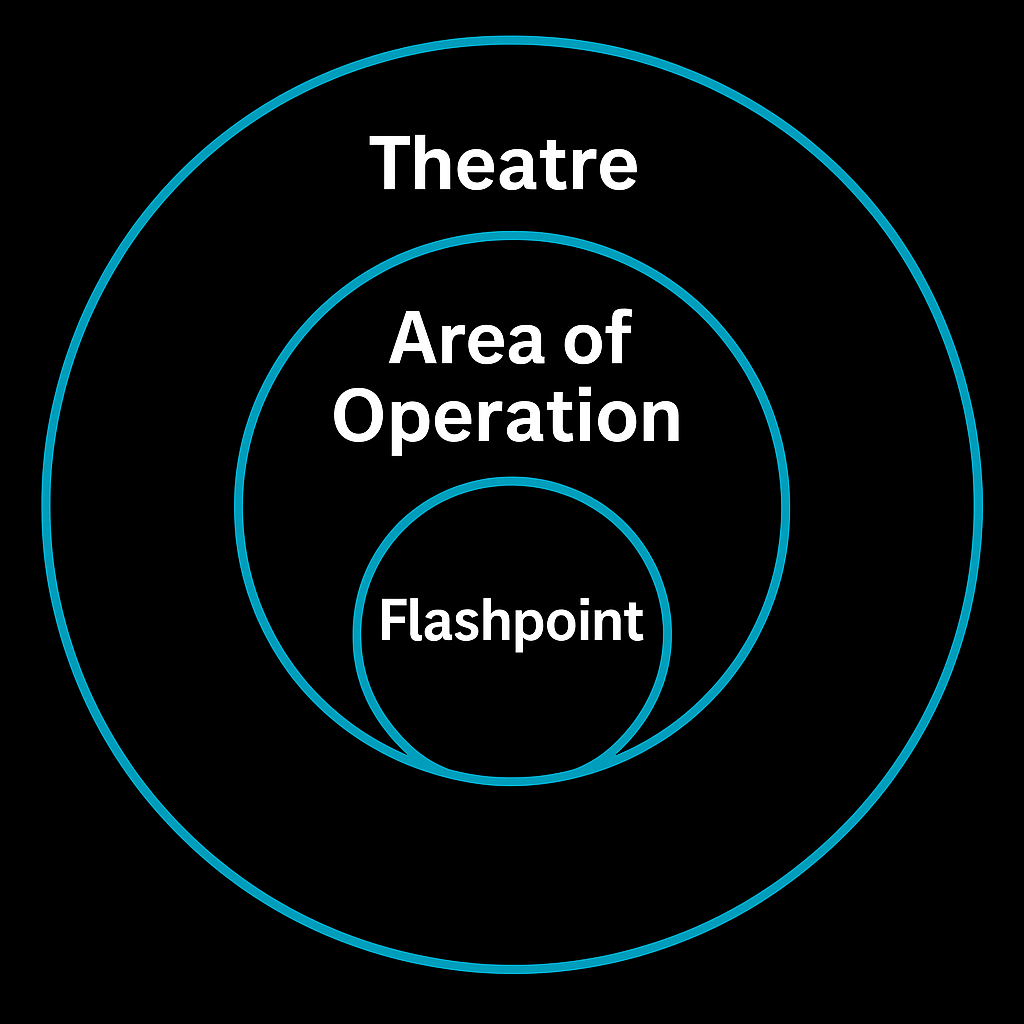
These distances are categorized into three zones: the Flash Point, the Area of Operation (AO), and the Theatre.
Typically, using skill test on a target in the AO from the Flash Point, or vice versa, incurs a 4 DS penalty. Attempts to use skill tests on targets in the Theatre from either the Flash Point or the AO, or vice versa, result in an 8 DS penalty if the GM deems it possible at all. For instance you GM might rule that you cannot detect a mouse in the theatre if you are in the flash point at all. Though might decide that with certain equipment you may be able to attempt with a penalty. Some weapons or equipment may reduce or eliminate these penalties, but unless otherwise specified, these penalties apply. Additionally, these penalties are cumulative with any other penalties from cover, obscurement, or environmental factors.
Attacking between zones can only be done with weapons that have an AO or theatre range value these suffer no penalties from range. Weapons with the AO and Theatre values are always considered in range when targeting the AO and or Theatre.
Weapons with AO value can target AO and flashpoint without the range penalty.
Weapons with theatre value can target theatre AO and flashpoint without the range penalty.
¶ The Flashpoint
The Flash Point refers to the area physically represented on the current scene or battlemap. Its main focus of the game and will shift to focus on where most players are or where the GM decides the most important parts of the story are happening. It is the focal point of the narrative and where most of the gameplay takes place. The boundaries of the Flash Point are typically defined by the edges of the gridded battlemap or set by the GM.
It’s important to envision the battlemap in three dimensions, with the height of the Flash Point being equal to its length and width. The Flash Point is dynamic and should shift between and within scenes to reflect the action of the game. Ideally, the Flash Point should be centered around the area where most players are located at any given time.
Players can enter or exit the Flash Point through its edges or via specific abilities or rules. For example, flying vehicles might exit the Flash Point vertically. Moving in or out of the Flash Point generally requires a full action.
¶ The Area of Operation
The Area of Operation (AO) extends from just outside the Flash Point to distances of tens or even hundreds of kilometres around it. Unlike the Flash Point, the AO does not have a specific battlemap and is not graphically represented in the game.
Similar to the Flash Point, entering or exiting the AO requires a full action. Characters and NPCs within the AO can interact with elements in both the Flash Point and the Theatre if they have the appropriate equipment.
¶ The Theatre
The Theatre encompasses the area extending from just outside the AO to hundreds or even thousands of kilometres beyond it. Like the AO, the Theatre lacks a specific battle map and is not graphically represented within the game.
Entering or exiting the Theatre requires a full action, similar to the Flash Point and AO. Characters and NPCs within the Theatre can interact with elements in the Flash Point and AO if they have the appropriate equipment.